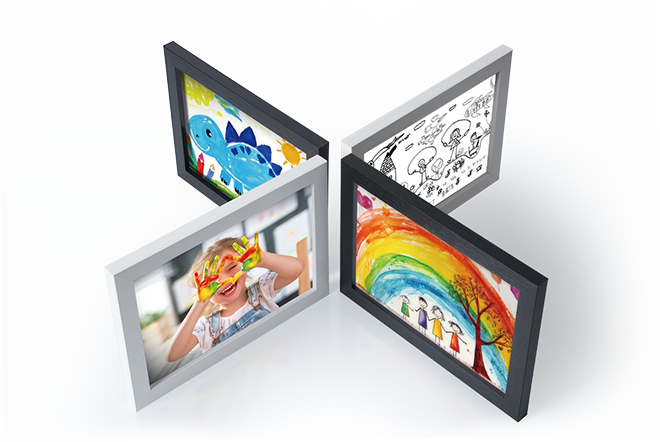
Large-format frames that stress wall fixings. Display systems that require two people to install. Wooden frames that warp after months of humidity exposure. For retailers, interior designers, and commercial display buyers, these are recurring problems that add cost and complexity to projects where the frame is supposed to be an asset, not a liability. Switching to an Aluminum Alloy Photo Frame resolves the core issue at the material level — delivering a frame that is structurally rigid and visually clean without carrying the weight that has always made traditional framing difficult to scale.
Wood frames are inherently dense. As frame sizes increase, weight scales with volume — a large wood frame for a commercial display or gallery installation can be genuinely heavy before glass or artwork is added. That weight transfers to the wall, the mounting hardware, and the handling process. For high-volume display environments or projects with many frames, the cumulative weight becomes a logistics and installation challenge.
Plastic frames avoid some of that weight but introduce a different problem: structural compromise. Thin plastic profiles flex under load, and over time, joints weaken — particularly in frames that are moved or repositioned regularly.
Wood absorbs and releases moisture in response to changes in humidity. In environments where temperature and humidity vary — retail spaces, homes near kitchens or bathrooms, exterior-adjacent walls — wooden frames warp and distort over time. The frame that was square and true at installation develops a bow or gap within months.
The visual result is a frame that no longer sits flat against the wall, corners that gap, and mitered joints that open. For commercial or gallery applications where presentation quality is a constant requirement, this is an unacceptable failure mode.
An Aluminum Alloy Photo Frame is a display frame constructed from extruded aluminum profiles rather than wood, plastic, or steel. The aluminum alloy used in frame production is a specific formulation that balances lightness with structural rigidity — producing a profile that holds its geometry under load while remaining significantly lighter than equivalent wood or steel.
Key structural characteristics:
The result is a frame system that can be assembled, disassembled, and reassembled without damaging the components — a practical advantage for commercial display environments where content changes regularly.
The reason Aluminum Alloy Photo Frames can be significantly lighter than wood frames of the same size without sacrificing structural integrity lies in the material's strength-to-weight ratio. Aluminum alloy is strong relative to its density — a thin-walled extruded profile delivers the rigidity needed to hold a glazed frame square while removing the material mass that makes wood frames heavy.
In practical terms, this means:
A common concern when transitioning from wood to aluminum is whether the lighter frame will feel less substantial. In practice, the extruded aluminum profile is dimensionally stable in a way wood is not. It does not flex under the weight of the glass it holds, it does not expand or contract with humidity changes, and it maintains the precise geometry of its corners over its full service life.
This dimensional stability makes Aluminum Alloy Photo Frames particularly well suited to applications where frames are installed in rows or grids — the consistent geometry means frames align precisely without the individual adjustments that wood frame installation often requires.
Steel frames and some metal hardware corrode in humid environments, producing visible rust that damages both the frame and whatever it is displaying. An Aluminum Alloy Photo Frame forms a stable oxide layer on its surface that protects the underlying metal from further oxidation. This natural protection, enhanced by anodizing or powder coating during manufacture, means the frame retains its appearance in conditions that would visibly damage steel or degrade wood.
For hospitality, coastal, or climate-variable installations where longevity is a significant procurement factor, this corrosion resistance translates directly to lower replacement frequency.
The anodized or powder-coated finish on an Aluminum Alloy Photo Frame is significantly harder and more scratch-resistant than painted wood or plastic surfaces. Anodizing integrates the color into the surface layer of the metal rather than sitting on top of it — so it does not chip, peel, or wear off the way paint does on a wood frame that is regularly handled.
For retail environments, display rentals, or any context where frames are moved, cleaned, and repositioned over time, this surface durability reduces the cosmetic maintenance burden compared to other frame materials.
| Factor | Wood Frame | Plastic Frame | Aluminum Alloy Frame |
|---|---|---|---|
| Weight | Heavy — increases with size | Light but structurally weak | Light with structural rigidity |
| Warping risk | High — moisture sensitive | Moderate — heat sensitive | None — dimensionally stable |
| Corrosion resistance | Low — requires treatment | Moderate | High — natural oxide layer |
| Long-term shape retention | Variable | Degrades over time | Consistent |
| Surface finish durability | Moderate — chips and scratches | Low | High — anodized or powder-coated |
| Installation ease | Requires heavy-duty fixings at scale | Adequate for small formats | Easy — lighter load on fixings |
| Suitability for large formats | Limited by weight | Limited by structural weakness | Well suited |
| Disassembly and reuse | Difficult — glued joints | Possible | Designed for reassembly |
Retail environments cycle through promotional content regularly. Frames need to be changeable without damage to the wall, the frame, or the content. An Aluminum Alloy Photo Frame can be opened, content replaced, and the frame closed and reused without the structural degradation that repeated handling causes in wood or plastic frames.
Large-scale retail wall displays — grids of uniform frames covering significant wall area — benefit from both the reduced installation weight and the visual uniformity that consistent extruded profiles produce.
Gallery applications require frames that are neutral in visual weight — the frame should support the artwork without competing with it. Slim aluminum profiles achieve this more reliably than wood frames, where the visible depth and texture of the material can draw attention. The precision of extruded aluminum corners also produces a cleaner presentation than hand-mitered wood joints.
For temporary exhibitions where the same frames are used across multiple installations, the durability and reassembly capability of aluminum frames deliver ongoing value that single-use or limited-reuse alternatives do not.
Office environments often require consistent framing across multiple units — certificates, awards, recognition displays, and branded interior elements. Aluminum alloy frames produce visual consistency across a set that wood frames, with their natural grain variation, cannot match. They are also lighter to ship and install when an organization is fitting out a new space or refreshing an existing one.
For interior design projects specifying frames across multiple rooms or multiple properties, weight and logistics are real project management considerations. Lighter frames reduce freight costs, simplify site installation, and reduce the risk of damage during transport — all of which affect project cost and timeline.
The quality of an Aluminum Alloy Photo Frame depends on the consistency of the extrusion process. Profiles with inconsistent wall thickness, visible surface defects, or poor anodizing coverage will produce frames that look acceptable in isolation but show variation when installed side by side. Requesting samples before volume orders and inspecting corner assembly quality, surface consistency, and dimensional tolerance is standard practice for commercial buyers.
Corners are the structural weakness point of any frame. Aluminum alloy frames use internal corner brackets, key connectors, or spring-loaded mechanisms to join profile sections. The method affects both structural rigidity and ease of assembly. For buyers who need to change content regularly, a spring-clip or key-connector system that allows tool-free opening is a practical advantage over systems that require tools.
Standard profile widths determine how the frame reads visually. Narrow profiles produce a minimal, modern aesthetic suitable for office and gallery applications. Wider profiles with more visible face area suit applications where the frame itself is part of the visual presentation. Confirming that the supplier can produce the range of sizes and profile widths required for the specific project, including non-standard sizes, prevents specification problems after ordering.
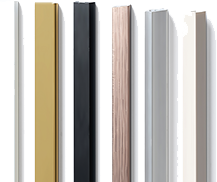
Standard finishes include silver anodized, black anodized, gold anodized, and powder-coated colors. For branded commercial environments, custom powder-coat colors may be required. Confirming available finish options and whether custom colors can be accommodated before committing to a supplier avoids design-stage compromises.
For buyers sourcing frames in volume — whether for retail chains, hospitality projects, gallery installations, or OEM supply programs — the quality consistency of the Aluminum Alloy Photo Frame across large orders matters as much as the individual product specification. Variation between production batches in surface finish, dimensional tolerance, or corner assembly quality creates visible inconsistency at the installation level.
JinHuan Art & Craft Products specializes in the manufacture of Aluminum Alloy Photo Frames for commercial, retail, and wholesale supply, with production capability covering a range of profile widths, standard and custom sizes, and surface finishes including anodized and powder-coated options. JinHuan Art & Craft Products Co., Ltd. supports OEM and custom specification programs for buyers requiring branded or project-specific frame solutions, and can provide samples, dimensional documentation, and production capacity information to support procurement decisions ahead of volume commitment.
Your email address will not be published. Required fields are marked *
No.18-1, Chunlan Road, Light Industrial Park, Lanxi City, Zhejiang Province, China
Phone+86-579-88766117
E-mail